Night plan
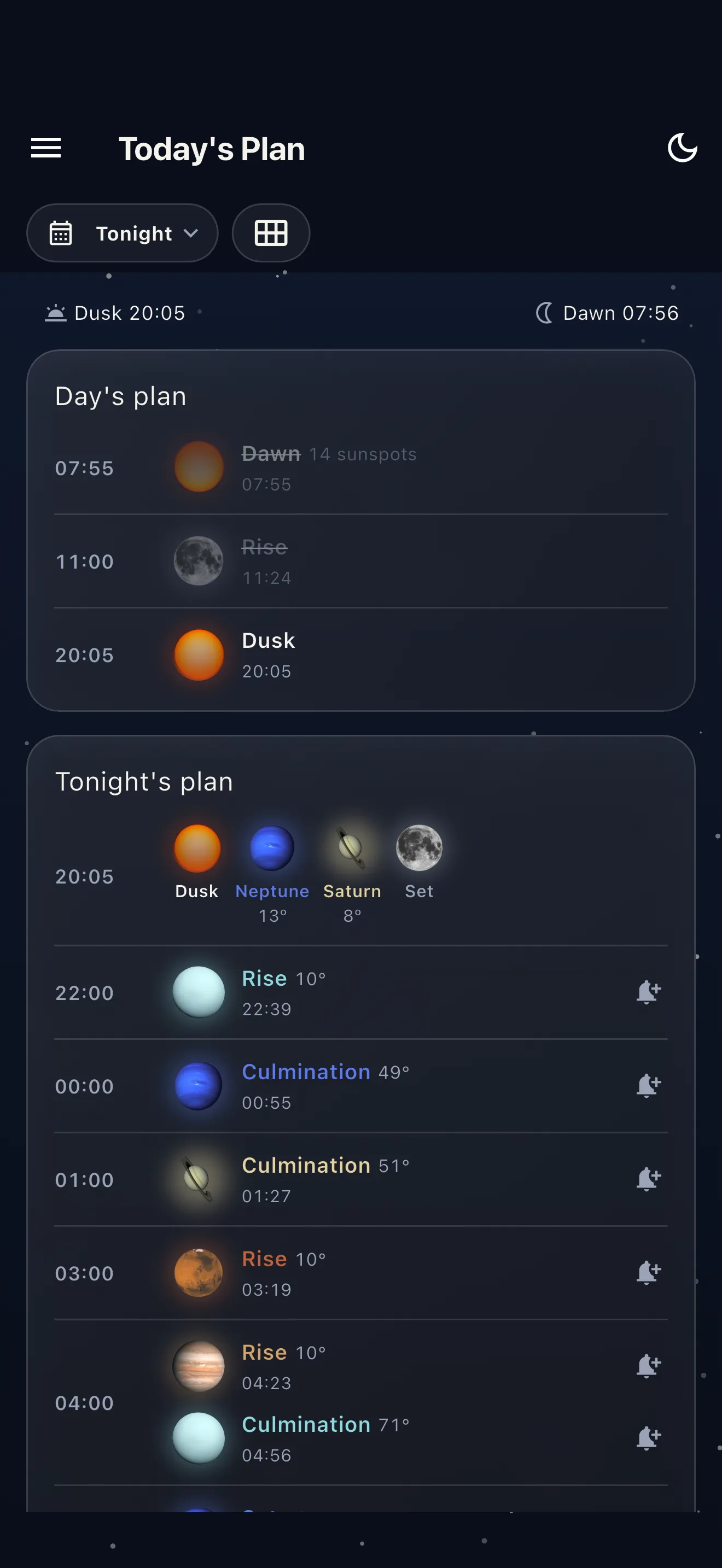
Sunrise and sunset, and the rise and culmination of each object with its altitude, hour by hour.
 KiPlanet
Earth overtakes Mars and the two planets line up with the Sun. KiPlanet tells you when it rises, when it peaks and how big it looks in your sky, and lets you know every night worth going out.
This is an aphelic opposition: Mars will look smaller than in 2022 (17.2″) or 2025 (14.6″). Every clear night counts, and the app marks them.
Today, . Ephemerides: ALPO, 2026-2027 apparition; JPL DE421. Opposition comparison: BBC Sky at Night.
KiPlanet is your observing guide for every night of the year: what rises, when and how high, how your gear will see it and whether the sky is on your side.
Sunrise and sunset, and the rise and culmination of each object with its altitude, hour by hour.
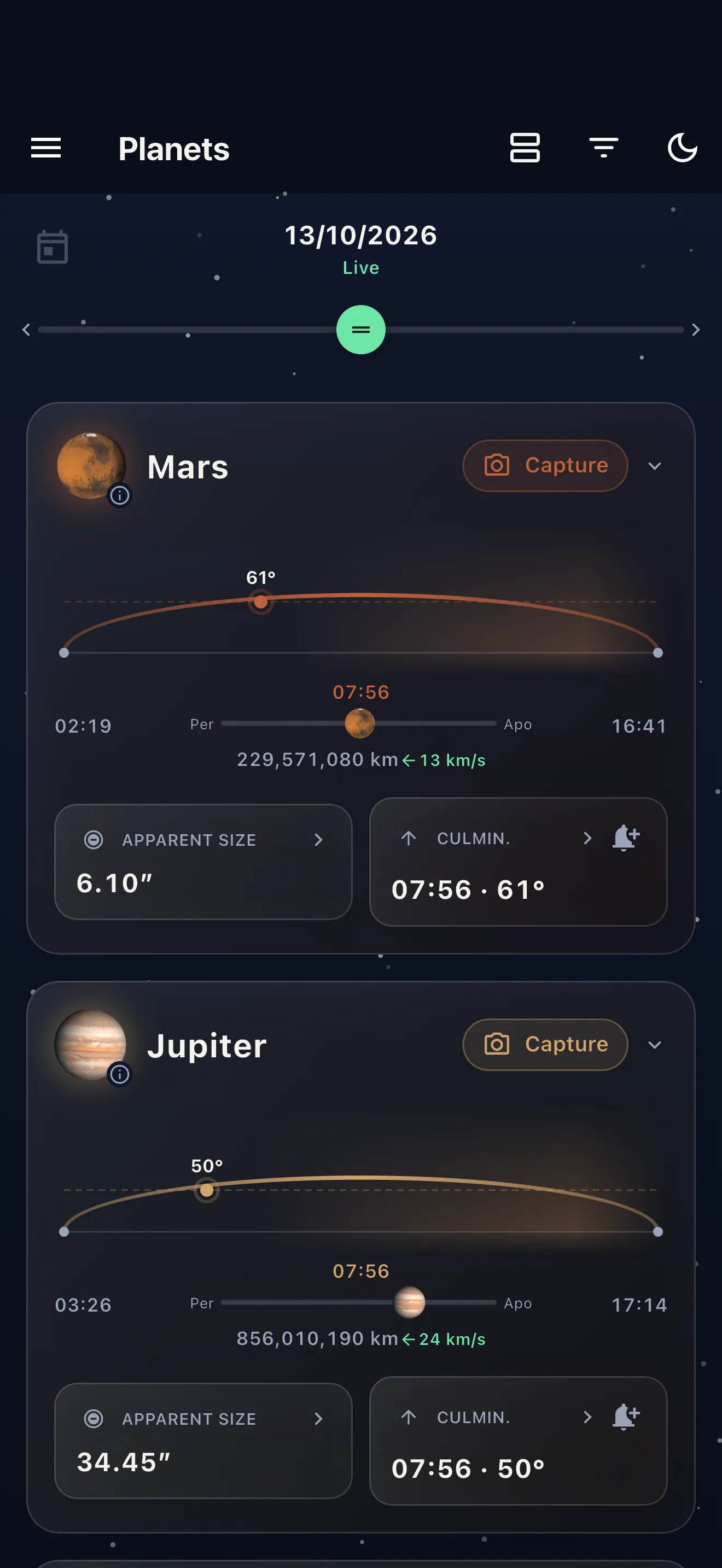
Daily arc, distance, speed and apparent size of each planet. Jump to any date.
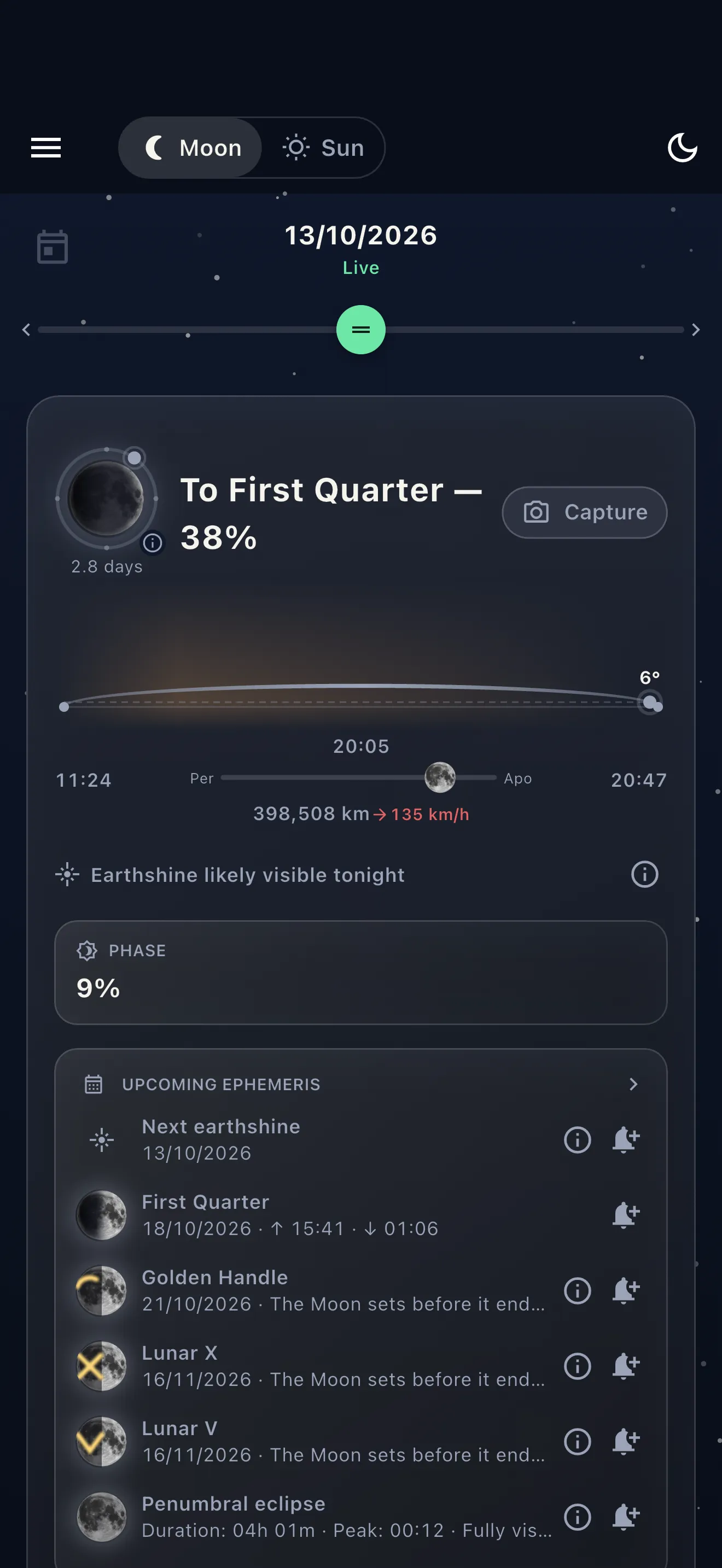
Phase, earthshine and lunar events such as the Golden Handle, the Lunar X and V, and eclipses.
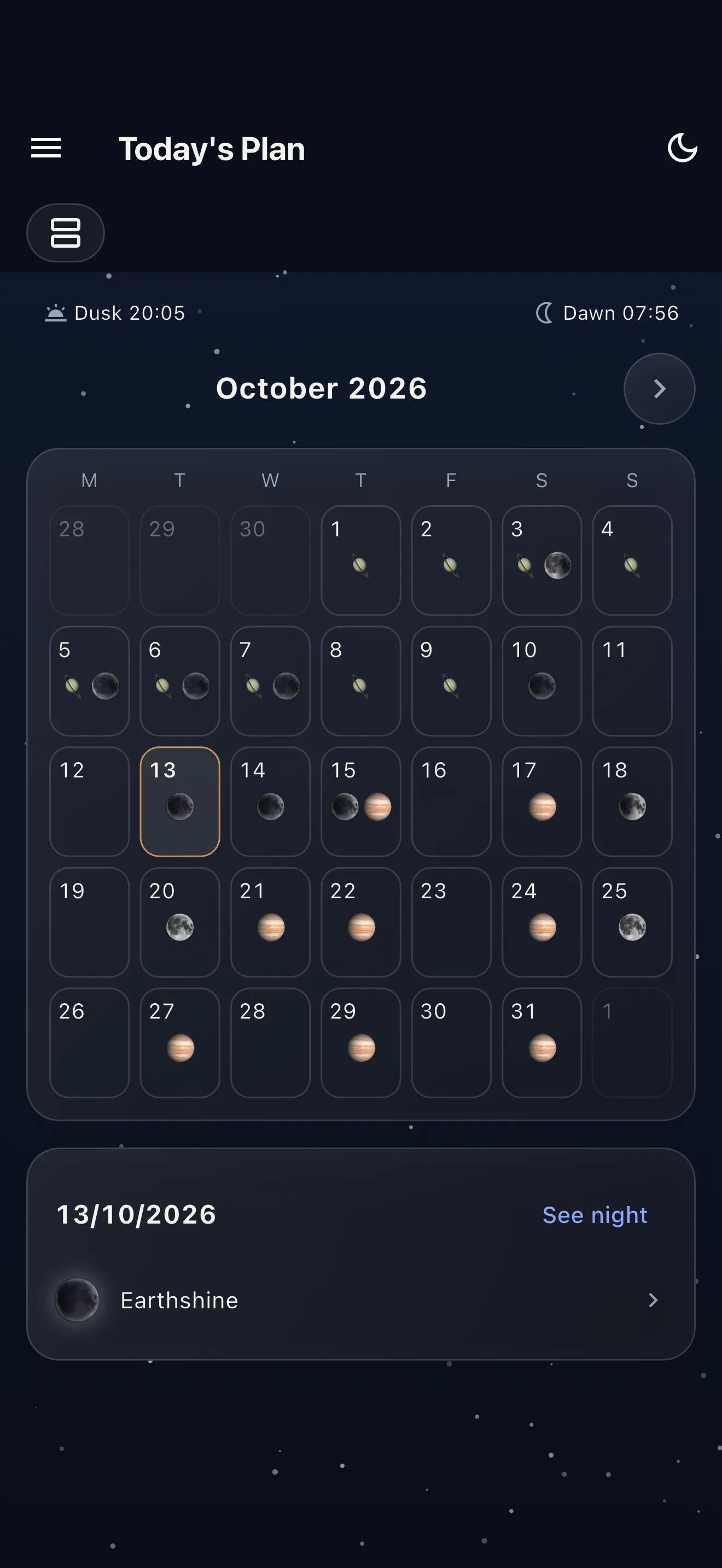
Every night of the month with its events at a glance, to plan sessions ahead.
Turn on an alert for any rise, culmination or event and never miss the good window.
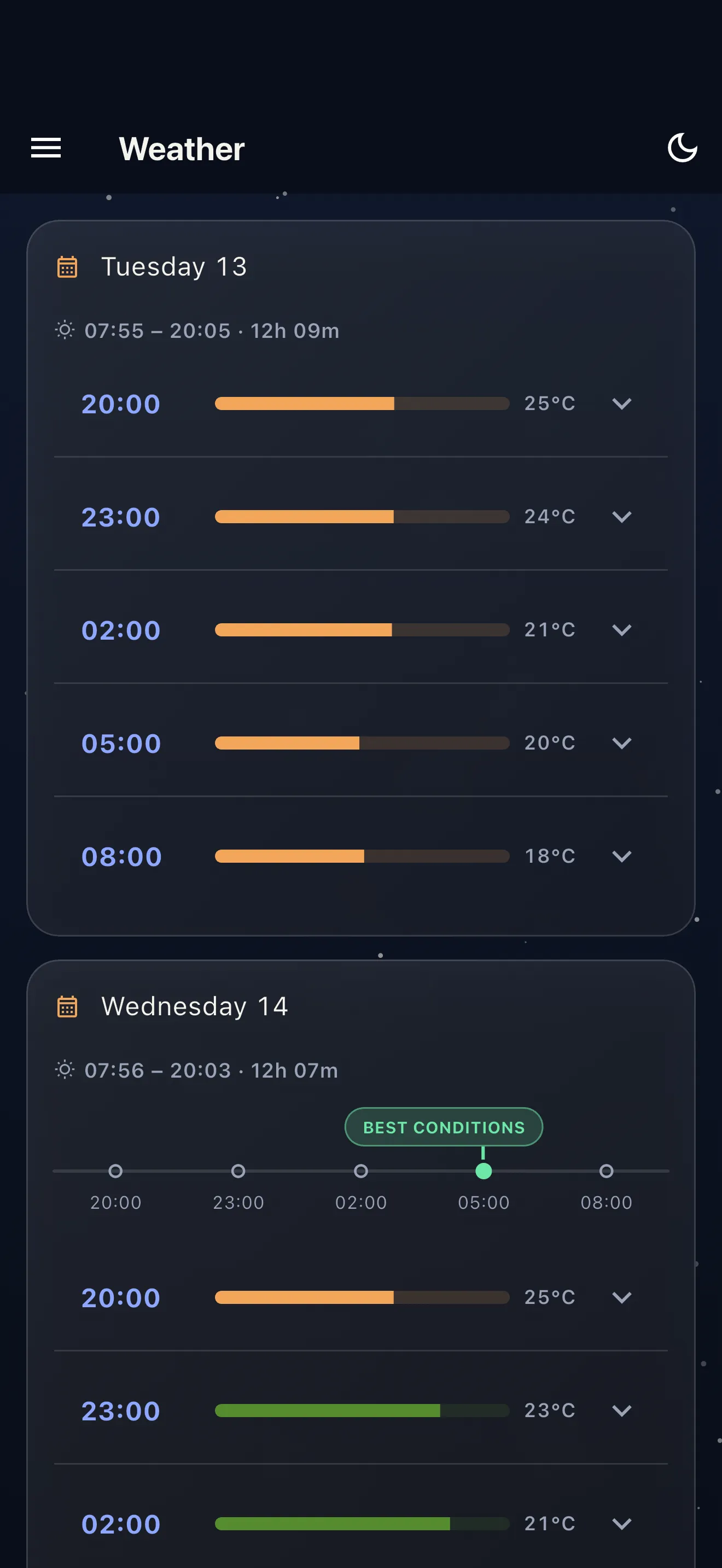
Night forecast in time slots, from 20:00 to 08:00, with the best-conditions hour marked.
See why a capture comes out badly: seeing, focus, dispersion, noise.
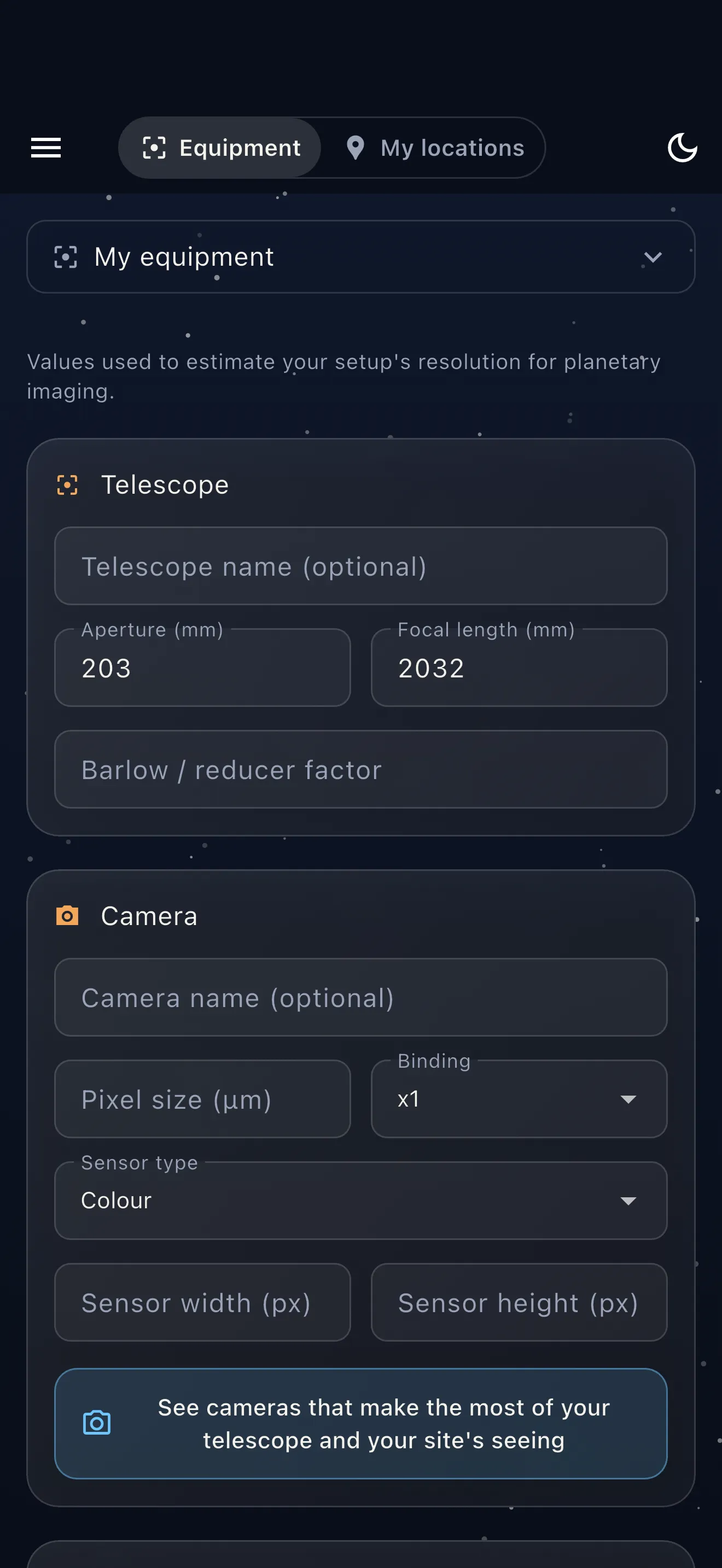
Save your telescope, camera and Barlow or reducer to estimate your setup's real resolution.
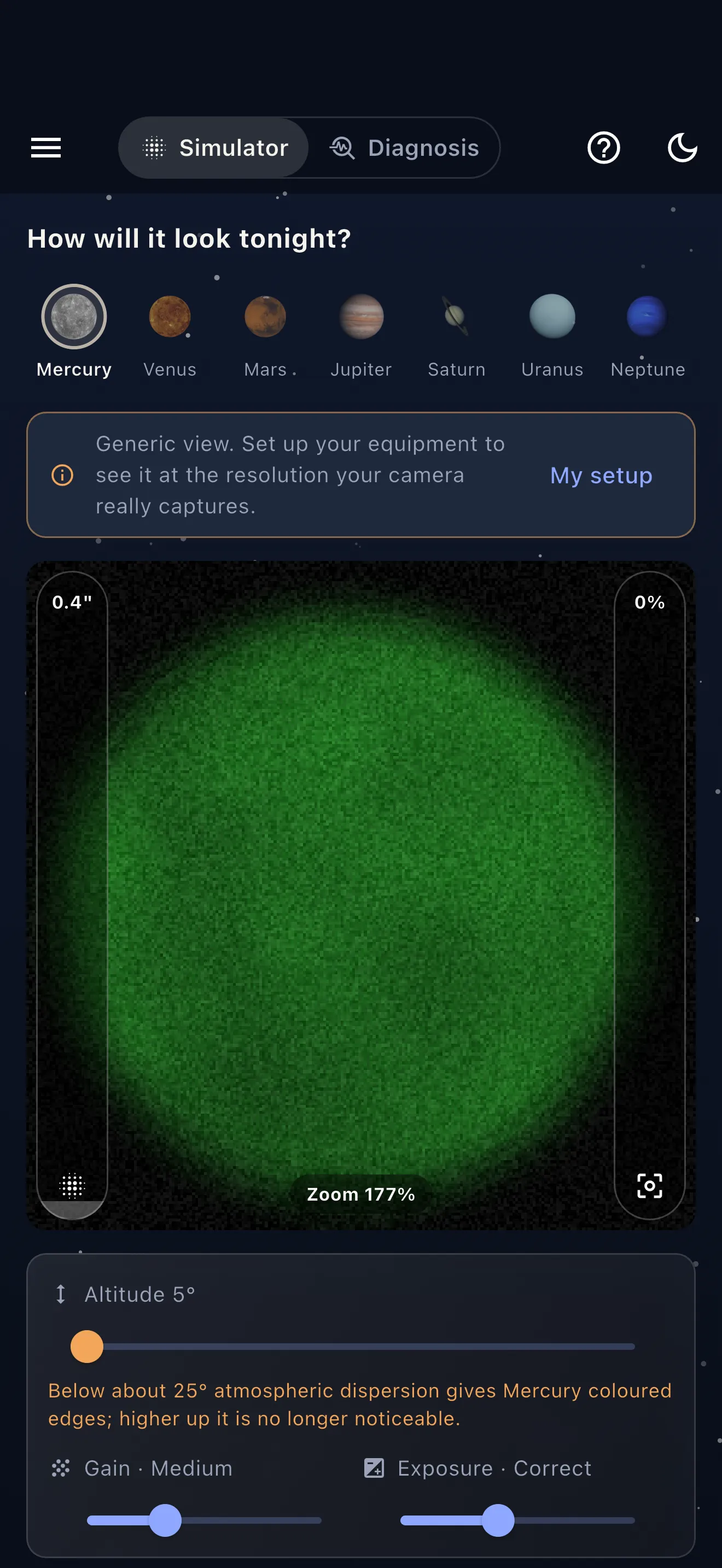
On 19 February Mars will be 13.8″ across. Pick your setup or type your focal length and your camera's pixel size, and see how many pixels its disc covers.
Same data as the My gear section of KiPlanet. With 1″ to 2″ of turbulence, more pixels do not always add detail, and the app takes your site's seeing into account.
On 19 February 2027 at 15:51 UTC. Mars is closest a few hours later, on 20 February, 101.4 million km away.
About 13.8 arcseconds. It stays above 10 arcseconds from 30 December 2026 to 14 April 2027.
A telescope of 150 mm or more, a planetary camera and a Barlow. KiPlanet works out the Barlow and the ROI for your camera.
No. Every calculation runs on the phone; only the weather, solar data and Jupiter transit files use the network.
Not yet. KiPlanet is on Android now, and the iPhone and iPad version is coming.
KiPlanet is free, with no account and no ads.